


I met her in a club that doesn't exist anymore, in a city I can't go back to. She was dancing like the loneliness drugs hadn't reached her yet, like she still remembered what it felt like to lose yourself in music and bodies and light. I was already medicated by then. Everyone was. But the way she moved made me feel like I was missing something.
She came out of the crowd and asked me for a cigarette. I had one. While I fumbled for my lighter she leaned in close enough that I could smell her, something like cut grass and rain under the club's recycled air, and said, "I like you."
Just like that.
"I never say that to people," she added, taking the cigarette from my fingers. "Even people I actually like." Then she turned and went back into the crowd. I didn't know her name yet. It was Mai.
I found her twenty minutes later at the bar. I came up behind her and put my hands on her waist, and she leaned back into me like we'd been doing this for years. The DJ dropped into something slow and heavy, and the world shrank to the two of us swaying there.
Her apartment was one of those old converted units in the tech district, clean lines and smart glass, the kind of place that adjusts the lighting to your mood. She had a cat named Honey who sat on the kitchen counter and watched us kiss our way to the bedroom with the face of a disappointed aunt.
I was doing tech maintenance in the district back then. Mai was studying xenobiology at the university, one of those fields that only exists because we got far enough out to need it. Late at night she'd talk about how life adapted to different gravities and different light. I didn't always follow, but I loved watching her face when she explained.
We had three months before her first mission. Three months of her apartment and Honey's stares and learning how her body fit against mine. By the time she came back I'd quit the job. Life was moving too fast to stay in one place, so we moved in together.
After that she went out every few months, and each time she came back with something. A chunk of moon rock that glowed faintly in the dark. A fragment of meteor in colours I didn't have names for. A vial of dust from a planet with three suns. Souvenirs, she called them. Proof she'd been somewhere I couldn't follow.
The last thing she brought me was an egg. Blue, smooth, cold to the touch, about the size of both my hands cupped together. Bigger than any egg I'd seen outside a museum.
"Take care of this for me," she said. She was leaving again in the morning.
I never saw her again.
We'd seen things together I couldn't have imagined before her. Nebula storms from the observation decks. Bioluminescent forests on a moon with no name. Nights where the stars were so thick it looked like someone had spilled light across the black, and she'd hold my hand and we'd just watch.
After she left, I couldn't do it anymore. Relationships, I mean. My parents wanted me to settle down and find someone new. I tried once or twice. But the part of me that knew how to reach people had gone quiet, not all at once, just gradually, like a room where someone keeps turning off one more light. The loneliness drugs helped. They made it easier to be alone. Everyone was on them by then anyway.
I kept the egg on a shelf in my quarters. Every new station, every new contract, it came with me. I told myself she was still out there doing whatever impossible thing she'd gone to do. The egg was proof she'd existed, proof we'd been real.
I kept it for a year and forty-seven days.
Then, one morning, I heard it crack.
It was so quiet I almost missed it. I was running diagnostics on the server arrays when I heard something that didn't belong, like ice giving way on a frozen lake.
I'd stopped thinking of the egg as anything but stone. For a year it had sat there, a monument to someone who wasn't coming back. Now there was a fracture running down its side, and as I watched, another line split the blue.
I forgot to breathe.
The shell fell away in pieces, and I don't know how to describe what I felt. It was as if every numb part of me woke at once and the drugs stopped working all together. Maybe it's what becoming a father used to feel like, back when people did that the old way.
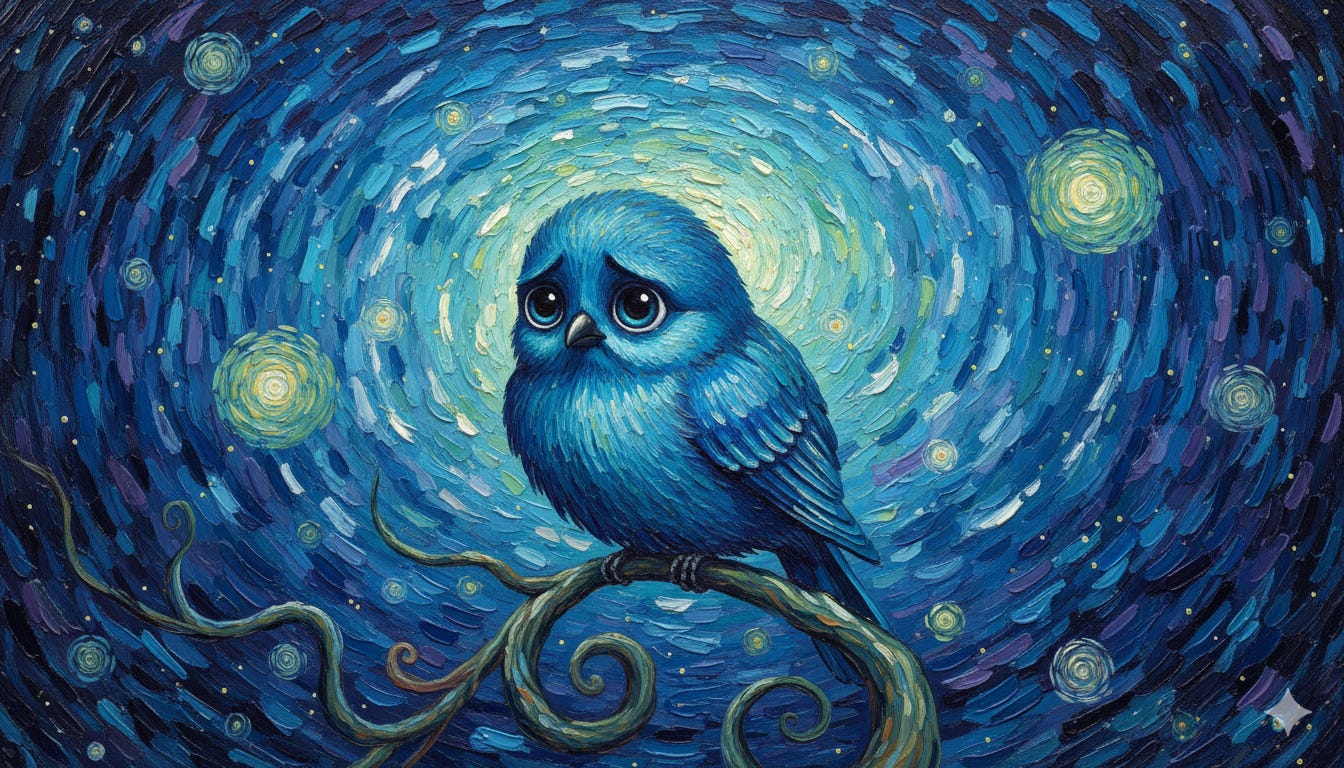
It was small and blue-feathered, with eyes too large for its head. It looked at me, and I understood that something alive had been waiting in the dark all this time while I treated it like a gravestone.
It opened its beak. No sound came out, but I felt something anyway, a vibration in my chest, a pressure behind my eyes. I wondered if it spoke in frequencies above or below human range. Whatever it was saying, the meaning was clear enough.
It needed me.
The habits came quickly.
It liked to nibble the hair on my legs while I worked, tugging gently with its beak, moving methodically from ankle to knee while I tried not to laugh. I'd be in the middle of a code review and it would be grooming me like I was another member of its flock.
It slept on my bed. It would hop up and land on my chest, heavier than something that small had any right to be, and stare into my eyes. Then, apparently satisfied, it would turn and settle into the crook of my arm.
I tried bird seed first, the standard nutri-pellets for exotic species. It looked at the bowl, looked at me, and swept it off the table with one wing.
Fish it loved. I had to special-order frozen supplies, but the way it tore into them, gleeful and a little savage, meant I couldn't say no.
I started calling it Duck. Not creative, but it fit.
Two months in, I realised the drugs had stopped working.
I'd taken loneliness suppressants for years. Everyone did. You took your dose, the hollow feeling went away, and you could live in your isolation without it eating you. For people like me, alone on server stations light-years from anyone, it was simply how you got through a shift.
Now I'd lie awake with Duck curled against my ribs and feel things. Grief. Mai's absence, like a bruise I kept pressing. I doubled the dose and nothing changed. The emptiness was back, except it wasn't empty anymore. It was full of her.
I started remembering things she used to tell me. How time runs differently when you travel far enough out. How she'd go on a six-month mission and come back having lived eight months, a year, more. How every time she left, she was moving away from me in time as well as space.
And the egg. How long had it been waiting? If she'd found it years before she gave it to me, if time ran differently where she'd been...
Duck's feathers glowed sometimes when it breathed, a soft blue-green pulse washing across my quarters with each breath. I'd watch it and wonder what kind of species this was, what they did, what they were for.
I didn't know what I was for anymore. Duck seemed to. It chose to sleep pressed against me. It groomed my leg hair and knocked over bowls, and it looked at me like I was worth looking at.
I realised the drugs had done more than kill the loneliness. They'd killed the need to understand.
For over a year I'd accepted that Mai was simply gone, on a mission somewhere. The drugs made it easy to shrug, to keep the egg on the shelf and never ask why she'd given it to me.
Now I couldn't stop asking. Where had she gone? What mission was worth never coming back from? Why the egg?
I went through the files she'd left on our shared drive, research I'd never bothered to open. Communications logs, mission briefings. Standard xenobiology surveys, sample collections, routine reports.
Then I found a folder labelled "Paradox Species - DO NOT SHARE."
Inside were hundreds of files. Images of creatures that looked almost like Duck. Video logs of Mai on a planet I didn't recognise, watching them in their habitat. And notes, pages of them in her handwriting. The first line read:
"They're dying. Not from disease or predation. They're dying because they've forgotten how to need each other."
I read through the night with Duck asleep on my lap.
She'd found them on a distant moon, a species of highly intelligent birds. She spent months watching them.
They used to be born live, she wrote. They lived in families, with parents who raised their young together and flocks that moved as one, their whole society built on constant contact.
Over generations, that changed. They evolved to lay eggs instead, eggs that could survive alone and didn't need immediate care. The young hatched into isolation and never learned to need each other the way their ancestors had. Each generation was more comfortable and more alone than the last, and now there were almost none left.
Her notes got more urgent toward the end. Phrases underlined twice, three times. "Same pattern." "We're not learning from them, we're following them." "The drugs are just the beginning."
I put the tablet down because my hands wouldn't hold it still. She'd seen our future in theirs.
The video was dated three days before she left. Mai in what looked like a research station, her hair shorter than I remembered, dark circles under her eyes.
"Hey," she said, with that crooked smile I'd forgotten I missed. "If you're watching this, the egg hatched. I wasn't sure it would. Time works differently out here. It's been six months for you, but almost four years for me. If I come back now, you'll be gone. And if I come back later..." She looked away from the camera. "There won't be anything to come back to."
She took a breath.
"The loneliness drugs weren't an accident. They studied species like Duck's, species that went extinct through comfortable isolation, and they saw a blueprint. Isolated people don't organise. They don't push back. They just consume and comply and slowly disappear."
"I have proof. But if I bring it back, they'll bury it, and me, and you. So I'm staying out here, documenting everything and sending it through channels they can't trace."
She leaned closer to the camera.
"The drugs won't work around it. I don't know why, something in its biology. You're going to feel lonely and it's going to hurt and you're going to want it to stop. Don't let it stop."
She blinked hard, twice.
"Take care of it. Let it take care of you. I love you. I'm sorry."
The video ended.
I stopped taking the drugs three days later.
The loneliness came back in a wave, sharp and total. I wanted them again. My hands shook reaching for the bottle, and Duck knocked it off the counter before I could open it, then sat there looking at me.
I let myself miss her properly. All of it: the impossibility of her stuck in a different stream of time, the anger at what they'd done to us and to everyone. It hurt like hell.
Duck stayed close. It groomed my leg hair and slept against my ribs, humming that low vibration through both of us.
A week later I did something I hadn't done in years. I opened a comm channel to another maintenance worker three stations over and just talked. About nothing. About Duck. About how the drugs had stopped working for me.
"Mine too," she said after a long pause. "I thought it was just me."
"It's not just you," I said.
Duck made its silent sound, and I felt it in my chest.
I didn't know if it would change anything. Probably not. The government was too big, the numbness too comfortable. But Mai had given me something that wouldn't let me settle into being alone, and I wasn't going to waste it. I'd keep talking to people, keep feeling things when they hurt, keep looking after this creature that shouldn't exist but did.
The next night I opened the channel again. She'd left it open too.